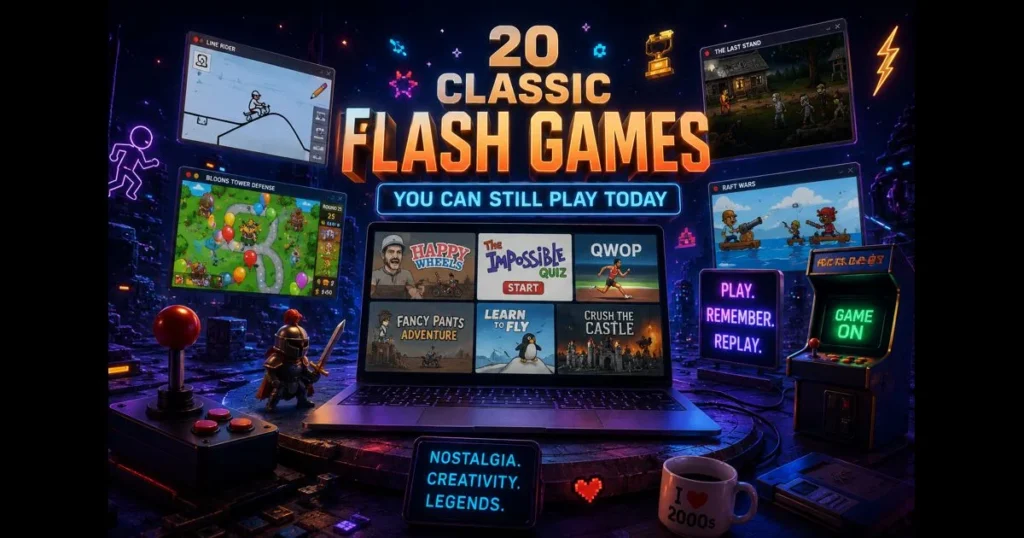
Classic flash games shaped a generation of web play. Small in file size yet rich in creativity, they transformed spare minutes in school labs and late-night browser sessions into shared experiences. If you feel a tug of nostalgia when you hear names like Line Rider, Bloons, or Happy Wheels, you’re not alone. These bite-sized games showed millions that great design doesn’t require a blockbuster budget—just strong ideas and a browser tab. In this guide, we revisit 20 all-time favorites and explain how to enjoy them today, whether via modern ports, safe emulation, or curated collections. We’ll also trace their role in online gaming history and why their design lessons still resonate in today’s HTML5 games and mobile hits. Ready to explore the best flash games—and discover a few you missed the first time? Let’s boot up the past, the smart way.
- The Rise of Flash Games
- What Makes a Classic Flash Game?
- Top 20 Classic Flash Games
- Where to Play Classic Flash Games in 2026
- The Transition from Flash to HTML5
- Community and Fan Engagement
- The Future of Classic Flash Games
- Conclusion: Celebrating Flash Gaming Heritage
The Rise of Flash Games
Before app stores and battle passes, browser tabs served as the arcade. Flash enabled independent creators to share their ideas with a global audience with little more than code and a portal account on platforms like Newgrounds, Kongregate, and Armor Games. This led to a surge of inventive prototypes, polished gems, and viral oddities that spread through word of mouth. (See: Flash game – Wikipedia.)
These titles lowered the entry barrier for both players and developers. You didn’t need a console or a powerful graphics card; just curiosity. Creators learned quickly by shipping small projects, reacting to player feedback, and iterating in public. This feedback loop established mechanics and genres we now take for granted—endless runners, physics sandboxes, idle clickers, and minimalist puzzle games.
Culturally, Flash became a shared language. A cryptic level code in a notebook, a lunchtime speedrun challenge, or a school computer that “somehow” loaded Happy Wheels—these moments stitched together a distinctive era of classic gaming.
What Makes a Classic Flash Game?
Ask five fans, and you’ll get five different lists of the best flash games. However, they’ll agree on a few traits that make a classic stand out:
- Instant readability: You grasp the game loop in seconds—shoot balloons, draw lines, click the odd one out—then discover depth through failure and mastery.
- Elegant scope: Short sessions, tight mechanics, and levels that respect your time.
- Signature feel: Physics quirks, snappy controls, or a distinctive art style that’s unmistakable in a crowded tab bar.
- Playful tone: Humor and surprise gags that turn challenges into conversations.
- Community hooks: Level editors, high scores, and replayable challenges that invite you to compare, compete, and share.
Nostalgia plays a role, but many old flash games still resonate because their constraints forced crisp design decisions. This discipline translates well to modern HTML5 games, mobile releases, and even full-fledged indie projects.
Top 20 Classic Flash Games
Here are 20 standouts—spanning puzzles, platformers, tower defense, physics toys, and delightful oddities. Each blurb highlights how it plays and why it still resonates in 2026.
Editor’s note: You might look for Alien Hominid, N, Stick RPG, GemCraft, or Bloons 6. They’re iconic, but we kept them off the core list for clarity: Alien Hominid’s definitive versions live on console/PC; N is best known in downloadable form with later browser ports; Stick RPG is a cult favorite but space is tight; GemCraft is a tower-defense staple, but we limited TD picks to keep genre variety; and Bloons 6 is a modern sequel rather than a Flash-era web game—we represent the series with its classic Flash entry instead.
1) Line Rider
Part toy, part art tool: you draw sledding tracks, then watch a rider trace your imagination—and your mistakes. The magic lies in its physics and the joy of tinkering until a small flourish makes a section shine.
Why it lasts: Infinite creativity. The modern HTML5 version keeps it alive, and community masterpieces continue to amaze.
2) Bloons Tower Defense (BTD)
Darts versus balloons sounds simple until maze layouts and special bloons force clever choices. Positioning and synergy rule the day.
Why it lasts: Accessible strategy. Modern BTD entries thrive on mobile and PC, while classic versions are preserved in collections and emulation.
3) Desktop Tower Defense
Minimalist visuals hide deep tactics as you place towers to create a maze. Pathing manipulation turns every build into a puzzle.
Why it lasts: Pure design. It’s a masterclass in emergent complexity from simple rules.
4) The Fancy Pants Adventure (World 1)
Fluid platforming, hand-sketched charm, and momentum-based movement that invites stylish runs. Surf loops, kick spiders, and treat every slope like a playground.
Why it lasts: Feel. Later console and PC releases exist, but the original spark still delights through preservation tools.
5) Happy Wheels
A physics obstacle course that blends skill, slapstick, and cartoon chaos. User-made levels create a bottomless pit of surprises.
Why it lasts: Endless variety and a robust HTML5 port on the creator’s site keep players laughing—and wincing.
6) QWOP
Four keys. Two legs. Infinite pratfalls. You control a sprinter’s legs, wrestling momentum and rhythm into forward motion.
Why it lasts: Perfect comedy loop. Easy to start, hilarious to fail, and oddly profound when it finally clicks.
7) Motherload
Dig, upgrade, go deeper. A deceptively chill mining loop that becomes a strategic juggle of fuel, cargo, and risk.
Why it lasts: Progression bliss. Its influence is evident in modern mining and survival roguelites, and the original remains a cozy time capsule.
8) Portal: The Flash Version
A 2D take on portal puzzles that emphasizes timing and spatial wit. It captures the essence of “think with portals” in side-view challenges.
Why it lasts: Smart adaptation. It stands on its own as a tight puzzle platformer preserved by fan archives.
9) The Impossible Quiz
Riddles, trick questions, and intentional misdirection. You’ll groan, laugh, and restart—then you’ll swear you won’t try again, but you will.
Why it lasts: Personality. Its meta humor and “gotcha” design feel like a conversation with the creator.
10) Crush the Castle
Precursor to many physics fling games. Launch stones at rickety forts, savoring the chain reactions as timber crumples and nobles tumble.
Why it lasts: Perfectly tuned destruction. A modern Legacy Collection on PC keeps its best levels neatly packaged.
11) Pandemic 2
Engineer a pathogen and watch human systems react. Strategy emerges from trade-offs between infectivity, visibility, and lethality.
Why it lasts: Systems storytelling. It remains a compelling lesson in cause, effect, and unintended consequences.
12) Run
Auto-runner with gravity-bending tunnels and snap decisions. Levels escalate from breezy to hypnotic as you chase flow state.
Why it lasts: Rhythm and clarity. Modern web ports preserve its crisp controls and minimalist charm.
13) Swords and Sandals
Gladiator RPG featuring turn-based duels and goofy swagger. Train stats, buy gear, and climb the arena ladder.
Why it lasts: Snackable progression. Multiple remasters on PC keep the vibe alive for new gladiators.
14) Super Smash Flash 2
Ambitious fan crossover fighter with robust mechanics and a passionate community. Local matches turned school breaks into mini-tournaments.
Why it lasts: Depth and devotion. A downloadable client from the creators sidesteps the demise of browser plugins.
15) Age of War
Side-view tug-of-war through historical eras. Balance unit spam with tech timing, then enjoy the push-pull shifts.
Why it lasts: Satisfying escalation. Simple inputs, big swings, eternally replayable.
16) Raft Wars
Turn-based water ballistics with siblings, treasure, and slapstick. Aim, arc, and account for waves and wind.
Why it lasts: Lighthearted precision. A remastered PC version and mobile ports make revisits easy.
17) Interactive Buddy
A physics sandbox that’s equal parts stress toy and experiment lab. Try tools, discover reactions, and create your own mini-challenges.
Why it lasts: Open-ended play. It’s less a game than a mood—endlessly fiddly in the best way.
18) Boxhead: 2Play Rooms
Isometric zombie survival with tight arenas and a co-op option that forged instant friendships. Kiting and upgrades are essential.
Why it lasts: Arcade purity. It nails the “one more try” loop, especially with a teammate.
19) Learn to Fly
Launch a penguin, upgrade gear, repeat—watching numbers climb as skill and stats compound. It’s a perfect idle-adjacent loop.
Why it lasts: Progress curve joy. Later sequels on PC extend the formula without losing the spark.
20) The Last Stand
Nightly defenses against the undead, daytime scrambles for survivors and supplies. Scarcity and tough calls drive the storytelling.
Why it lasts: Atmosphere and stakes. A curated PC collection preserves the classic trilogy for modern systems.
Where to Play Classic Flash Games in 2026
The safest, most comprehensive route is the flashpoint archive by BlueMaxima—an offline launcher with a curated library and preservation-minded tech so you can browse, click, and play without risky plugins. It’s widely recommended for old flash games because it handles dependencies, versions, and media that web mirrors often miss.
If you prefer the web, Newgrounds and Armor Games host many titles via the ruffle flash emulator, which runs Flash content through modern browser tech. The Internet Archive’s Software Library offers in-browser emulation as well. For studio-specific troves, the Ninja Kiwi Archive on PC preserves a wealth of classic releases from that team. TotalJerkface keeps Happy Wheels current in HTML5, and Line Rider’s official site runs a smooth web build.
You generally cannot “allow flash in browser” anymore; modern browsers disabled the plugin years ago for security reasons. Avoid shady prompts and stick to trustworthy emulators or offline launchers.
If you’d rather not curate your own set, start with collections and ports: The Last Stand: Legacy Collection, Crush the Castle Legacy, and other re-releases on PC storefronts wrap classic content in stable engines. For quick nostalgia bursts, many portals still let you play flash games online through safe, built-in emulation.
The Transition from Flash to HTML5
Flash’s decline didn’t happen overnight. Security concerns, battery drain on laptops, and the rise of smartphones without plugin support pushed developers toward open web standards. When Adobe ended support, it was clear the future would run on open tech that didn’t require a proprietary runtime.
HTML5, JavaScript, and WebAssembly became the modern canvas. They run across devices, don’t rely on a single vendor, and integrate nicely with accessibility and performance tooling. For creators, this meant fewer roadblocks between an idea and a playable, shareable build; for players, it meant faster loads and longer battery life.
Many classics made the jump. Happy Wheels switched to a web build without losing its edge. Line Rider thrives with modern drawing tools. Armor Games Studios packaged series like The Last Stand and Crush the Castle into tidy PC releases. Bloons’ tower-defense lineage evolved into robust mobile and PC entries, while spiritual successors like Super Motherload reimagined Motherload’s core loop as a full-scale game. The lesson is clear: design that excels on a tight budget carries beautifully to new tech.
Community and Fan Engagement
The culture around these games remains vibrant. Discord servers compare speedrun strategies for Run and Fancy Pants movement tech. Players exchange riddles and tips for The Impossible Quiz. Nostalgia stream nights highlight oddities like Interactive Buddy and QWOP, turning failure into comedy gold.
Creation continues, too. Level editors and remasters unlock fresh possibilities—Happy Wheels user maps, Line Rider art rides, and modded challenges that push physics engines to the brink. Fans also preserve manuals, sprites, and lore on wikis so new players can confidently jump in. It’s classic gaming as a living museum: curated, participatory, and always just a link away.
The Future of Classic Flash Games
Emulation keeps improving. As Ruffle and similar projects mature, more titles will run smoothly in browsers without risky plugins. Expect launcher apps that bundle proven emulators, metadata, and cloud saves, making your personal mini-arcade portable and safe.
Preservation will likely expand, too. Archives and museums increasingly treat browser games as cultural artifacts worth saving with context, not just files. With creators’ blessing, we can anticipate more official collections—clean ports, commentary tracks, and extras—so the best flash games feel as accessible as a favorite album.
Hardware isn’t out of the question either. Handhelds and mini-PCs that boot directly into curated libraries could provide couch-friendly ways to revisit retro games born in the browser. Wherever these titles land, the throughline is care: respectful licensing, accurate feel, and community input to ensure nothing vital gets lost in translation.
Conclusion: Celebrating Flash Gaming Heritage
Flash may be gone as a plugin, but its spirit endures—in the speed of modern web experiments, the confidence of indie design, and the muscle memory when you launch a penguin into a slingshot or draw a perfect slope. These 20 classics are more than quick distractions; they’re chapters in online gaming history, proving that constraints spark invention and joy can scale beautifully down.
Ready to jump back in? Pick three from the list—one puzzle, one platformer, one wild card—and try them tonight via the Flashpoint archive, a trustworthy web portal running the Ruffle Flash emulator, or an official remaster. Tell a friend, swap scores, and keep the lineage alive. The browser tab that started it all still has plenty to give.
Frequently Asked Questions
What are classic flash games?
Classic flash games are browser-based games that were created using Adobe Flash technology. They gained immense popularity in the early 2000s and include various genres such as platformers, puzzles, and shooters.
Why did classic flash games decline in popularity?
The decline of classic flash games can be attributed to the discontinuation of Adobe Flash Player in 2020, along with the rise of more advanced gaming technologies and mobile gaming platforms that offered enhanced graphics and gameplay experiences.
Are classic flash games still playable today?
Yes, many classic flash games can still be played today through emulators and websites that have preserved them. Some developers have also re-released their games using HTML5 or other modern programming languages.